
If you are sourcing compostable bags for different international markets, there is no single certification that is automatically “best” everywhere.
The right choice depends on four factors: the target market, the intended composting environment, the specific product, and the applicable certification scope or local requirements.
As a practical starting point, buyers commonly encounter BPI Certification in North America, EN 13432-based industrial compostability requirements and certification schemes such as OK compost INDUSTRIAL in Europe, and AS 4736 or AS 5810 verification in Australia. Home-compostability requirements must be evaluated separately.
The important point is that a standard and a certification are not the same thing, and a certificate held for one product does not automatically cover every compostable bag produced by the same supplier.
Why Compostability Certification Is a Procurement Issue
For packaging buyers, compostability certification is not simply a logo to place on retail packaging.
It can affect whether a product claim can be supported, whether a product matches the intended waste-management pathway, whether a certification mark can legally be used on the finished packaging, and whether the actual product specification falls within the certificate scope.
This is why asking:
“What certifications does your factory have?”
is not enough.
A better question is:
“Which certification or standard applies to this specific finished product, in this specification, for the market where we intend to sell it?”
First, Understand the Difference Between a Standard and a Certification
This distinction is fundamental.
ASTM D6400 is a technical standard widely used for evaluating plastics and products intended for aerobic composting in municipal or industrial facilities.
EN 13432 is a European standard covering packaging recoverable through composting and biodegradation. It sets a test scheme and evaluation criteria for packaging intended for this recovery route.
AS 4736 and AS 5810are Australian standards covering commercial and home compostability respectively. The Australasian Bioplastics Association operates verification programmes against these standards.
By comparison:
BPI Certification, OK compost INDUSTRIAL, OK compost HOME, and the ABA certification programmes are certification or verification schemes that assess eligible products against specified requirements or standards.
This means that saying “EN 13432 certification” may be convenient shorthand in everyday business communication, but technically EN 13432 itself is the standard. A third-party certification scheme may then demonstrate conformity with that standard.
Understanding this difference makes it easier to compare certificates from different suppliers.
North America: When Does BPI Matter?
For buyers targeting the United States and Canada, BPI is one of the most recognisable compostability certification programmes.
BPI currently offers two types of compostability certification:
Commercial Only Certification, for eligible products intended to break down in commercial composting facilities; and
Commercial & Home Certification, for eligible products that meet both commercial and properly managed home-composting requirements.
For commercial certification, BPI uses ASTM D6400 as its base assessment standard, with other ASTM standards applicable to certain eligible product structures.
This is an important update for buyers because BPI should no longer be described simply as an “industrial composting certification.” Its Commercial & Home programme began accepting applications in December 2025 and is now part of BPI’s current certification system.
However, buyers should still verify the specific certified product in BPI’s public product catalogue instead of assuming that every item manufactured by a BPI-certified supplier is covered.
Europe: EN 13432 and OK compost INDUSTRIAL Are Not the Same Thing
For European industrial-compostability projects, EN 13432 remains an important technical reference.
EN 13432 covers the requirements for packaging recoverable through composting and biodegradation and has historically been a harmonised European packaging standard.
OK compost INDUSTRIAL, however, is a certification scheme operated by TÜV AUSTRIA. It should therefore not be described as if it were another name for EN 13432. TÜV AUSTRIA separately operates certification schemes including OK compost INDUSTRIAL and OK compost HOME.
There is another important development for European buyers.
The EU Packaging and Packaging Waste Regulation, Regulation (EU) 2025/40, generally became applicable on 12 August 2026. It introduces new rules for compostable packaging, while the European Commission is also working toward updated harmonised standards for industrial and home compostability. Existing EN 13432 remains relevant, but buyers should not assume that an EN 13432-based certificate by itself answers every future PPWR compliance question.
For procurement teams, the practical approach is therefore:
check the product certification, the specific packaging application, the destination country, and the latest applicable EU requirements together.
What About the United Kingdom?
The UK should not simply be treated as identical to the EU.
For example, the current Environment Agency resource framework recognises independently certified industrially compostable packaging complying with EN 13432, EN 14995 or ASTM D6400 for relevant composting inputs.
For home-compostable items, the framework recognises several routes, including EN 17427, AS 5810, NF T51-800 and TÜV AUSTRIA’s OK compost HOME requirements.
This illustrates why a simple rule such as “OK compost for Europe and the UK” is too broad.
UK buyers should confirm the intended application and actual collection or composting pathway before deciding which documentation is appropriate.
Australia: AS 4736 or AS 5810?
Australia has a clearer distinction between two major compostability standards.
AS 4736 addresses biodegradable plastics suitable for commercial composting and other microbial treatment.
AS 5810 addresses biodegradable plastics suitable for home composting.
The Australasian Bioplastics Association operates verification programmes for both standards.
However, there is an important procurement limitation.
ABA currently restricts AS 4736 and AS 5810 certification to eligible products that actively help divert food waste into organics recycling. Not every product made from compostable material is automatically eligible. ABA specifically states, for example, that compostable mailers are not accepted under these certification programmes.
Certification also does not automatically guarantee acceptance in every FOGO or kerbside organics programme. Local councils, collection systems and composting facilities may have their own acceptance rules.
For Australian projects, buyers therefore need to confirm both:
the applicable compostability standard
and
the actual local end-of-life pathway.
What About Home Compostability?
Home compostability should never be treated simply as a “higher level” version of industrial compostability.
The two environments operate under very different conditions.
Commercial composting facilities generally provide controlled biological processing conditions, while home composting occurs under lower and more variable temperatures and depends heavily on how the compost system is managed.
Different markets therefore use different home-compostability schemes and standards.
Examples include:
BPI Commercial & Home Certification in North America;
OK compost HOME from TÜV AUSTRIA;
AS 5810 verification through the ABA in Australia.
A home-compostable claim should only be used when the specific finished product is covered by the appropriate certification or supporting conformity route for the target market.
Certification Does Not Mean a Product Will Degrade Everywhere
This is one of the most important points for packaging buyers.
A compostability certification demonstrates that a product meets specified requirements under defined composting test conditions.
It does not mean that the bag can be discarded in soil, rivers, oceans, roadside environments or landfill and be expected to disappear within a fixed period.
Actual decomposition conditions depend on factors such as temperature, moisture, microbial activity, product thickness and the treatment environment.
Compostable bags should therefore be directed to an appropriate accepted composting pathway where one exists.
Product Certification Is Not the Same as a Factory Audit
Buyers should also separate product-level compostability verification from factory-level audits and management systems.
For example, BPI, OK compost and ABA programmes relate to product compostability claims and defined certificate scopes.
By contrast, systems and audits such as ISO 9001, ISO 14001, BSCI, Sedex, HACCP, BRC or customer-specific factory audits address different aspects of quality management, environmental management, social compliance, food-safety management or manufacturing controls.
They may all be important during supplier qualification, but they do not replace one another.
A factory passing a social or quality audit does not make every product compostable.
Likewise, a compostability certificate does not by itself demonstrate the manufacturer’s complete production, quality or social-compliance capability.
Buyer Checklist: What Should You Verify Before Ordering?
Before approving certified compostable bags, procurement teams should confirm:
1. What is the target country or region?
2. Is the product intended for commercial or home composting?
3. Which standard applies to the intended claim and application?
4. Which certification or verification body issued the documentation?
5. Does the certificate cover the exact finished product, formulation and relevant thickness range?
6. Is the certificate current and verifiable through the certification body’s official database?
7. Does the buyer have the necessary right to use the certification mark on private-label packaging?
8. Will the intended local composting or collection system actually accept the product?
These questions are more useful than simply asking a supplier to send “all available certificates.”
How Ecopro Supports Certified Compostable Packaging Projects
Ecopro Manufacturing Co., Ltd. is a compostable packaging manufacturer based in Dongguan, China, producing compostable bags and films for international B2B markets.
Ecopro operates an approximately 18,800 sqm production facility with more than 60 automated production lines and annual production capacity of approximately 15,000 tons. Approximately 95% of production is exported, with major markets including the United States, Canada, the European Union, the United Kingdom, Australia and New Zealand.
Depending on the specific product and certificate scope, Ecopro’s compostable packaging portfolio may be supported by standards or certification programmes including BPI/ASTM D6400, OK compost HOME, OK compost INDUSTRIAL, EN 13432, AS 4736 and AS 5810.
Certification availability should always be confirmed for the specific product, material system, thickness, application and target market rather than assumed across Ecopro’s entire product range.
For custom projects, buyers can provide the product type, target market, dimensions, thickness, printing, packaging format and required compostability claim so that the appropriate product specification and certification documentation can be reviewed before production.
Frequently Asked Questions
Is BPI better than OK compost?
Neither is universally “better.” They are different certification systems used in different markets and applications. Buyers should select documentation according to the target market, product and intended composting environment.
Is EN 13432 a certification?
No. EN 13432 is a European standard for packaging recoverable through composting and biodegradation. Certification schemes can assess and certify conformity with applicable requirements based on this standard.
Are BPI and EN 13432 interchangeable?
No. They have technical similarities in industrial compostability assessment, but certification or compliance in one system should not automatically be treated as satisfying another market’s requirements.
Does a supplier’s certification cover every bag it manufactures?
No. Certificate scope must be checked for the actual product, formulation, thickness and other applicable conditions.
Does compostable certification mean the bag can be thrown into nature?
No. Certified compostability relates to specified composting environments and test conditions. It does not mean the product should be littered or will predictably biodegrade in soil, seawater or landfill.
The Key Procurement Principle
The best compostability certification is not simply the certificate with the most recognisable logo.
The correct decision is:
Target Market → Product Application → End-of-Life Pathway → Applicable Standard → Certification Scope
Once these five factors are clear, buyers can determine which documentation should be requested from the manufacturer.
If you are developing certified compostable bags for North America, Europe, the UK, Australia or New Zealand, contact Ecopro to discuss product specifications, samples, certification documentation, custom printing and private-label packaging before placing a production order.
Email: sales_09@bioecopro.com
WhatsApp: +86 15218784866
(the “Site”) is for general informational purposes only. All information on the Site is provided in good faith, however, we make no representation or warranty of any kind, express or implied, regarding the accuracy, adequacy, validity, reliability, availability or completeness of any information on the Site. UNDER NO CIRCUMSTANCE SHALL WE HAVE ANY LIABILITY TO YOU FOR ANY LOSS OR DAMAGE OF ANY KIND INCURRED AS A RESULT OF THE USE OF THE SITE OR RELIANCE ON ANY INFORMATION PROVIDED ON THE SITE. YOUR USE OF THE SITE AND YOUR RELIANCE ON ANY INFORMATION ON THE SITE IS SOLELY AT YOUR OWN RISK.
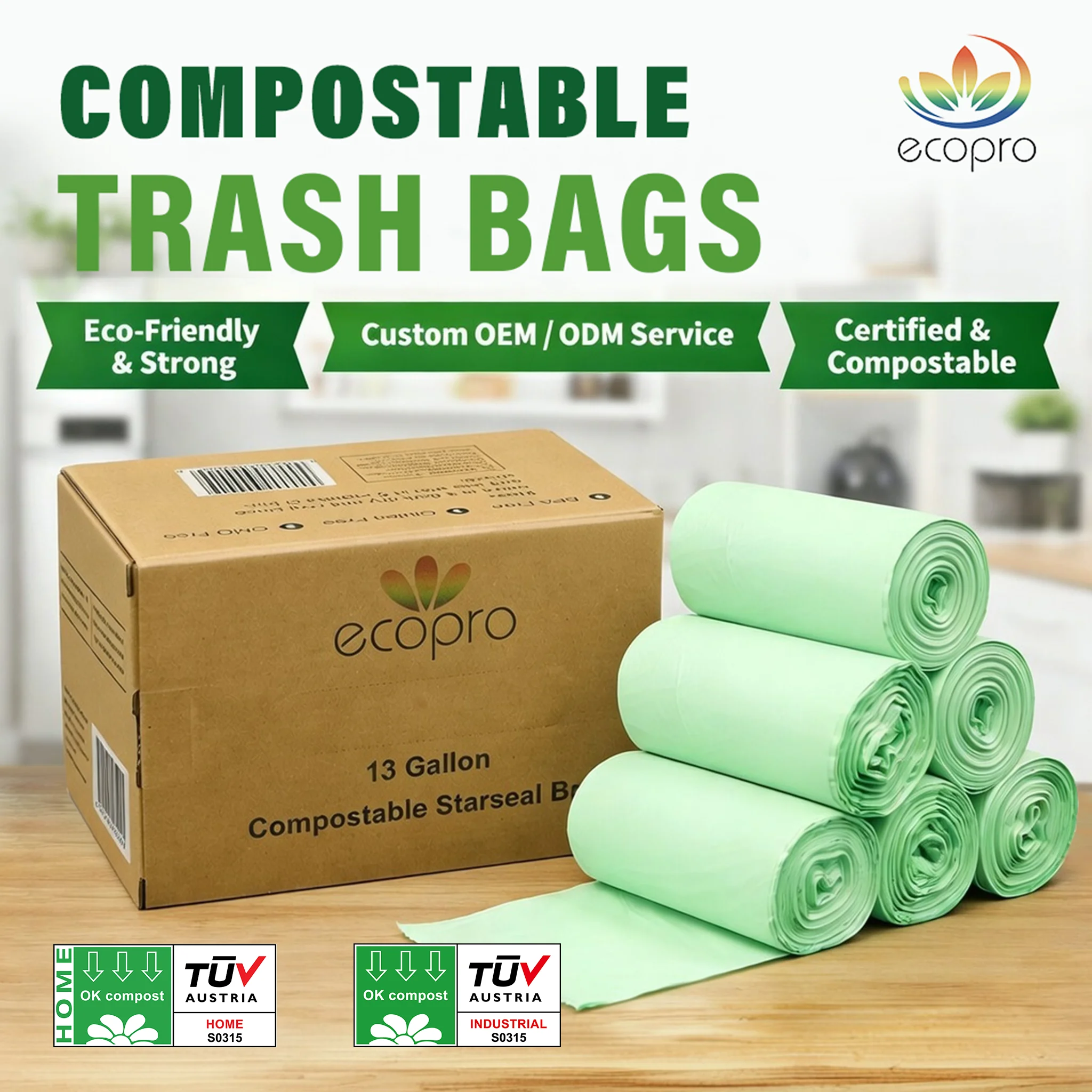
compostable trash bags
compostable trash bags
Post time: Aug-19-2026