
Customizing a compostable bag involves much more than choosing a size and adding a logo.
Before requesting a final quotation or approving mass production, buyers should clearly define the application, bag structure, dimensions, performance requirements, compostability requirements, artwork, packaging, quantity, quality criteria, and delivery schedule.
A small change in thickness, printing, packaging, or certification scope can affect the product performance, MOQ, cost, lead time, and even whether the finished bag matches the requirements of the target market.
For brands, retailers, distributors, and importers, a good custom packaging project therefore starts with one thing:
a clear and complete product specification.
1. Start With the Application and Bag Structure
Before deciding the material or thickness, first explain what the bag will actually be used for.
A compostable trash bag, produce bag, courier bag, pet waste bag, resealable bag, and film all have different performance and production requirements.
Buyers should confirm:
- Intended application;
- Bag length and width;
- Bag construction;
- Bottom or side gusset, if applicable;
- Handle or drawstring design;
- Opening or closure style;
- Roll, flat-pack, or individual format;
- Intended contents and expected load.
If the bag needs to fit a specific bin, product, dispenser, retail box, or packaging machine, provide the relevant dimensions or reference sample.
A technical drawing, existing bag, or target application photo can often prevent misunderstandings that a simple “600 × 800 mm” specification cannot.
2. Define Thickness and Performance Requirements
Many buyers begin a project by asking:
“What material should I use?”
But for most custom packaging projects, the more useful starting point is:
“What does the finished bag need to do?”
Depending on the application, buyers may need to define:
- Target thickness;
- Flexibility;
- Strength;
- Seal performance;
- Puncture or tear resistance;
- Transparency or appearance;
- Opening performance;
- Load requirement;
- Storage and use conditions.
Compostable bags may use material systems based on PBAT, PLA, starch, or combinations of compostable materials, but the appropriate structure should be evaluated according to the finished product and applicable certification requirements rather than selected only by raw-material price. The original project brief also identifies material structure, thickness, flexibility, and strength as key customization factors.
Two bags with the same thickness do not necessarily provide identical performance.
Material structure, film processing, bag construction, seal design, and actual use conditions all matter.
For this reason, buyers should define the required finished-product performance, then evaluate the specification through samples and application testing.
3. Confirm the Required Compostability Standard and Certification Scope
If the finished product will be marketed as compostable, this requirement should be discussed before artwork and production begin.
One important distinction is often overlooked:
A standard and a certification are not the same thing.
For example:
- ASTM D6400 is a technical standard used as the base assessment standard in BPI’s commercial compostability certification programme.
- AS 4736 and AS 5810 are Australian standards for commercial and home compostability respectively, with verification programmes operated by the Australasian Bioplastics Association.
- OK compost INDUSTRIAL and OK compost HOME are certification schemes operated by TÜV AUSTRIA.
The correct requirement depends on:
- Target country or region;
- Product type;
- Intended composting environment;
- Finished-product formulation;
- Thickness;
- Printing and additives;
- Intended compostability claim;
- Certificate scope.
Do not assume that because a manufacturer has one compostability certificate, every product it manufactures automatically carries the same certification.
Australia provides a useful example. ABA currently limits AS 4736 and AS 5810 certification to eligible products that actively support food-waste diversion into organics recycling; compostable mailers, for example, are not currently accepted under those programmes.
Certification eligibility therefore needs to be reviewed for the specific product and application.
4. Lock the Printing, Artwork and Certification Marks
For private-label and printed compostable bags, artwork should be treated as part of the technical specification rather than as a final cosmetic step.
Buyers should confirm:
- Number of printing colours;
- Pantone or approved colour reference;
- Logo size;
- Printing area;
- Printing position;
- Artwork file;
- Artwork version;
- Barcode or QR code;
- Disposal instructions;
- Regulatory information, where applicable;
- Certification marks, if required.
The most important step is to identify one final approved artwork version before production.
If artwork is revised several times, sales, production, QC, and packaging teams should all work from the same approved version.
This avoids one of the most common problems in customized packaging: the bag itself is produced correctly, but an outdated barcode, label, logo, or artwork file is used.
Can You Put a Certification Logo on a Private-Label Bag?
Not automatically.
Certification marks are controlled trademarks and may only be used according to the relevant programme’s rules.
For example, TÜV AUSTRIA states that the OK compost INDUSTRIAL logo may only be applied to a product that is formally certified, and the claim must not imply other properties such as home compostability or soil biodegradability.
ABA likewise states that trademark rights do not automatically transfer to third parties. A sublicense and trademark agreement may be required for a customer selling an already-certified finished product under its own brand.
Therefore:
confirm certification-logo usage rights before approving private-label artwork.
5. Confirm the Retail and Shipping Packaging
The bag itself is only one part of a customized packaging project.
Buyers should also define how the finished product will be packed.
Possible formats include:
- Rolls;
- Flat packs;
- Inner bags;
- Paper bands;
- Labels or stickers;
- Retail boxes;
- Display packaging;
- Master cartons.
Confirm:
- Bags per roll or pack;
- Rolls or packs per carton;
- Retail packaging dimensions;
- Barcode position;
- Label requirements;
- Carton dimensions;
- Shipping marks;
- Private-label information.
These decisions affect more than appearance.
They can change:
- Product cost;
- Carton weight;
- CBM;
- Warehouse efficiency;
- Retail presentation;
- Freight cost;
- MOQ.
For supermarket or e-commerce projects, packaging requirements should therefore be defined at the same time as the bag specification.
6. Understand What Determines MOQ
A common buyer question is:
“What is your MOQ?”
But for customized packaging, there is rarely one MOQ that applies to every product.
A better question is:
“What is the MOQ for this exact specification?”
MOQ can be affected by:
- Bag dimensions;
- Material requirements;
- Thickness;
- Printing;
- Printing setup or plates;
- Number of SKUs;
- Retail packaging;
- Material preparation;
- Production setup;
- Machine efficiency.
A standard or existing specification may support a different starting quantity from a fully customized bag with new printing and retail packaging.
This is why:
MOQ is usually a result of the specification, not an independent product parameter.
If you are launching a new product, also ask whether the manufacturer can offer:
- Existing specifications for evaluation;
- Sample development;
- A suitable trial quantity;
- A staged production plan.
Sharing both the initial order quantity and estimated annual demand can help the manufacturer evaluate a more practical production plan. This principle was already correctly reflected in the source draft.
7. Define the Approved Sample and Quality Criteria
Quality requirements should be agreed before mass production, not after the goods are finished.
Depending on the product, buyers may need to define:
- Dimensional tolerance;
- Thickness tolerance;
- Measurement method;
- Seal performance;
- Load or strength requirements;
- Tear or perforation performance;
- Printing quality;
- Appearance requirements;
- Packing requirements;
- Inspection criteria.
For customized projects, it is useful to establish:
Approved Sample + Product Specification + Tolerance + Inspection Criteria
The approved sample provides a physical reference for appearance, feel, printing, and product structure.
The written specification defines measurable requirements such as dimensions, thickness, tolerances, quantities, and packaging.
Both should be used together.
For repeated orders, version control is also important. If the dimensions, artwork, packaging quantity, barcode, or other specification changes, the final approved version should be clearly identified before the next production run.
The original draft already recommends using an approved sample, specification sheet, or product drawing as a mass-production reference.
8. Confirm Lead Time, Forecast and Delivery Requirements
The final point is timing.
Do not ask only:
“How many days is production?”
A complete project schedule can include:
- Specification review;
- Sample preparation;
- Sample approval;
- Artwork confirmation;
- Printing preparation;
- Material availability;
- Mass production;
- Packaging;
- Quality inspection;
- Shipment.
For a first custom order, these stages may require more time than a repeat production run.
Buyers should therefore provide:
- Required sample date;
- Target order date;
- Required delivery date;
- Expected shipping method;
- Seasonal deadlines;
- Repeat-order forecast where available.
For recurring or high-volume orders, advance forecasts can help the manufacturer coordinate materials and production capacity more effectively.
What Information Should You Send for an Accurate Quotation?
A professional inquiry does not need to be complicated.
Ideally, send the supplier:
Product Type + Application + Size + Bag Structure + Thickness / Performance Requirement + Printing + Packaging + Quantity + Target Market + Certification Requirement + Required Delivery Date
For example:
Compostable trash bag
45 × 60 cm
Star seal
20 bags/roll
For household food waste
Custom two-colour print
Private-label retail box
100,000 bags initial order
Target market: UK
Relevant compostability documentation required
If the exact specification is not yet known, send:
- A reference sample;
- Existing product specification;
- Technical drawing;
- Target application;
- Photos of the current packaging.
The manufacturer can then review the project rather than quoting against incomplete assumptions.
How Ecopro Supports Customized Compostable Packaging
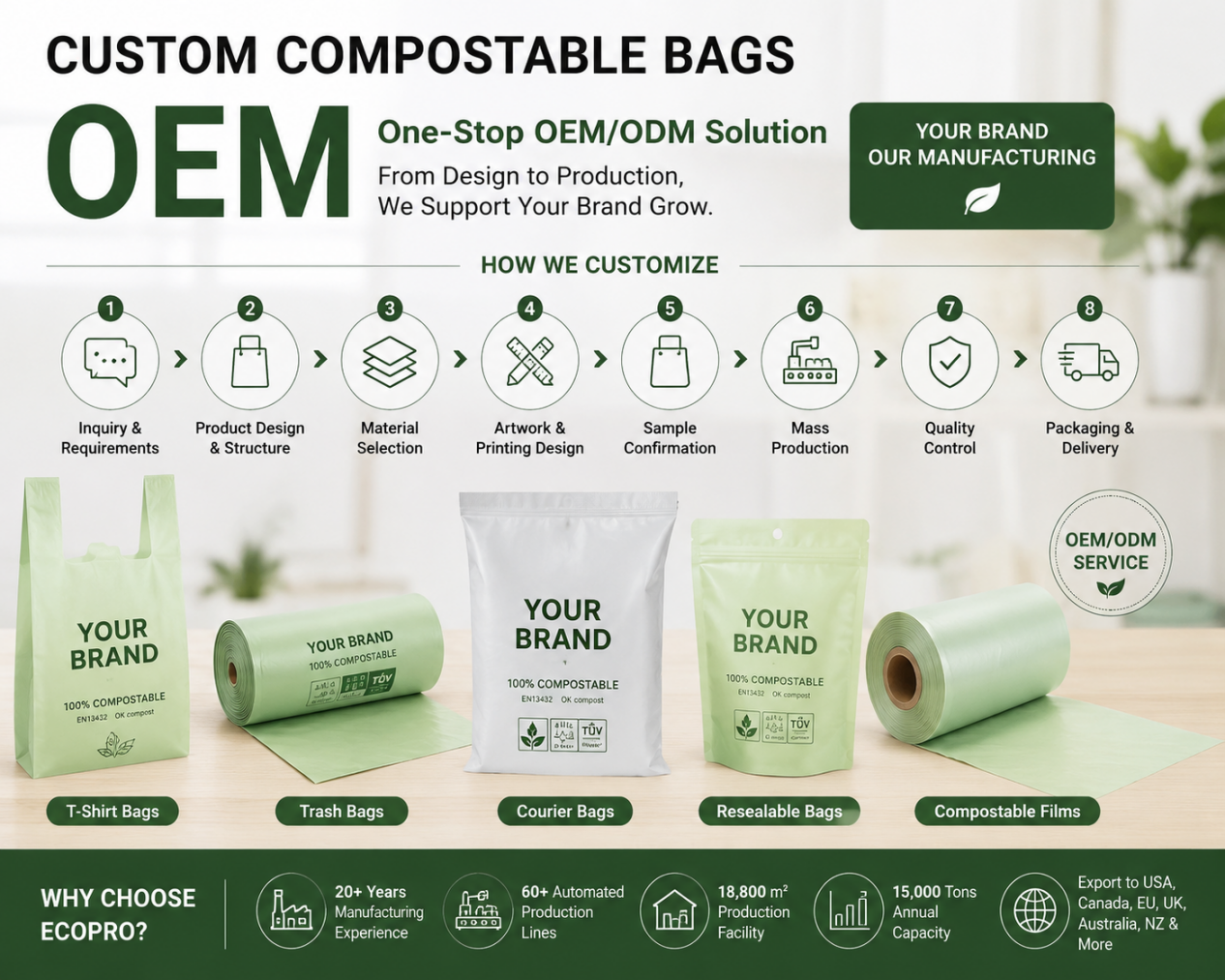
Ecopro Manufacturing Co., Ltd. is a compostable packaging manufacturer based in Dongguan, China.
The company operates an approximately 18,800 sqm production facility with more than 60 automated production lines and annual production capacity of approximately 15,000 tons. Its customized product portfolio includes compostable trash bags, courier bags, resealable bags, films, and other compostable packaging solutions.
For customized projects, Ecopro can review:
- Product application;
- Bag structure;
- Size and thickness;
- Performance requirements;
- Printing;
- Packaging;
- Quantity;
- Target market;
- Relevant certification requirements;
- Production schedule.
Certification availability is confirmed according to the specific product, application, material system, thickness, and certificate scope rather than assumed across the entire product range.
Buyers can provide an existing specification, reference sample, drawing, or project requirements for evaluation before sample development and quotation.
Frequently Asked Questions
What information do I need before requesting a custom compostable bag quotation?
At minimum, provide the product type, application, size, bag structure, quantity, printing requirements, packaging method, target market, and expected delivery date. Thickness and certification requirements can then be reviewed according to the application.
Can I use my own logo and private-label packaging?
Yes, custom printing and private-label packaging can be evaluated according to the bag type, printing requirements, artwork, quantity, and packaging format.
Can I print a compostability certification logo on my custom bag?
Only when the product is covered by the applicable certification and the required trademark or licensing conditions are satisfied. Certification-logo usage should be confirmed before artwork approval.
Why does MOQ change between different custom bags?
MOQ depends on the complete specification, including material requirements, dimensions, printing, packaging, number of SKUs, and production setup. A standard unprinted product and a fully customized private-label product may therefore have very different MOQs.
Does the supplier’s compostability certificate automatically cover my private-label bag?
No. Buyers should verify whether the exact finished product, formulation, thickness, printing system, and intended claim are within the relevant certificate scope. For some certification schemes, separate licensing or sublicensing requirements may also apply.
Conclusion
Customizing compostable bags is not simply:
Choose a size → Add a logo → Ask for a price.
A more reliable process is:
Application → Product Structure → Performance → Certification → Artwork → Packaging → MOQ → Quality Standard → Delivery
The clearer these requirements are before production, the more accurately the manufacturer can evaluate cost, samples, MOQ, lead time, and production feasibility.
For buyers, this reduces specification misunderstandings and makes quotations from different suppliers easier to compare.
Planning a custom compostable packaging project? Send Ecopro your product requirements, reference sample, or drawing to discuss specifications, samples, certification documentation, private-label packaging, and production options.
Learn more: https://www.ecoprohk.com/
Email: katherine@bioecopro.com
WhatsApp: +86 18929223742
The information provided by Ecopro on https://www.ecoprohk.com/ is for general informational purposes only. All information on the Site is provided in good faith, however, we make no representation or warranty of any kind, express or implied, regarding the accuracy, adequacy, validity, reliability, availability or completeness of any information on the Site. UNDER NO CIRCUMSTANCE SHALL WE HAVE ANY LIABILITY TO YOU FOR ANY LOSS OR DAMAGE OF ANY KIND INCURRED AS A RESULT OF THE USE OF THE SITE OR RELIANCE ON ANY INFORMATION PROVIDED ON THE SITE. YOUR USE OF THE SITE AND YOUR RELIANCE ON ANY INFORMATION ON THE SITE IS SOLELY AT YOUR OWN RISK.
Post time: Aug-27-2026