
Choosing a reliable compostable packaging supplier requires more than comparing unit prices. Buyers should first confirm whether the supplier has sufficient production capacity, a structured quality control process, and a practical approach to trial orders and customized projects.
These three questions help brands, retailers, importers, and packaging distributors evaluate whether a manufacturer can support both the initial order and future repeat business. Buyers should also verify that any compostability certificate applies to the exact product, material structure, thickness, and target market rather than assuming that one certificate covers every item a factory produces.
Why Supplier Selection Matters for Compostable Packaging
Compostable packaging is a technical product category. Product performance can be affected by material structure, film thickness, bag dimensions, sealing parameters, printing requirements, storage conditions, and the intended application.
A supplier may be able to produce a basic compostable bag but still lack the systems required to manage:
- Custom dimensions and thicknesses;
- Private-label printing and retail packaging;
- Different compostability requirements across markets;
- Seasonal or repeat-order production;
- Product consistency between batches;
- Technical documentation and certificate verification;
- Delivery planning for international shipments.
For this reason, procurement teams should evaluate the manufacturer’s production system and project-management capability instead of relying only on samples, quotations, or general sustainability claims.
Question 1: Are You a Manufacturer, and Can You Supply Consistently?
The first question should establish whether the supplier operates its own manufacturing facility and whether its capacity is suitable for the buyer’s expected order volume.
A trader may be able to source products from different factories, but buyers seeking repeat supply, customized production, or stable specifications generally need greater visibility into where and how the products are manufactured.
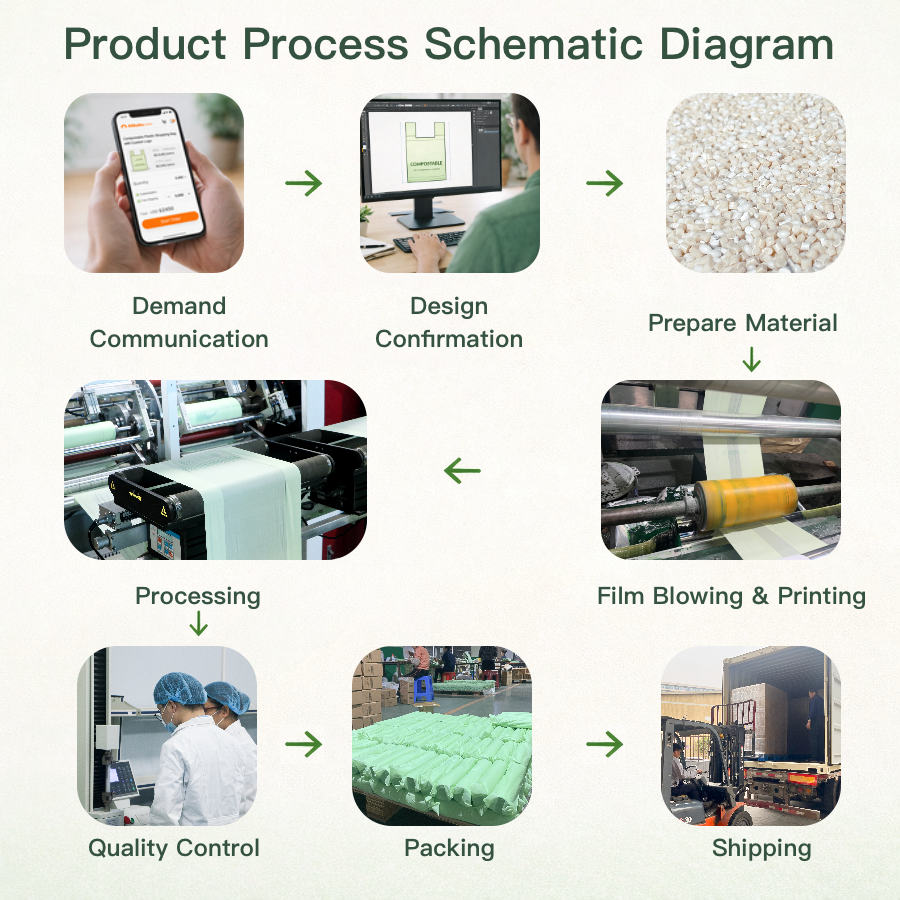
Ecopro Manufacturing Co., Ltd. is a compostable packaging manufacturer based in Dongguan, China, producing compostable bags and films for international B2B markets. The company operates an approximately 18,800-square-metre production facility with more than 60 automated production lines and an annual production capacity of approximately 15,000 tons. Its export markets include the United States, Canada, the European Union, the United Kingdom, Australia, and New Zealand.
However, total factory capacity is only one part of the evaluation. Buyers should also ask:
- Is the product manufactured regularly or only occasionally?
- Does the specification require a dedicated production setup?
- Are the required materials normally available?
- How are seasonal and repeat orders scheduled?
- Can the supplier reserve capacity for forecasted orders?
- How will changes in artwork, packaging, or quantity affect the lead time?
A reliable supplier should review the complete specification before confirming production timing. Bag size, thickness, printing, packaging format, material availability, order quantity, and machine scheduling can all affect the final lead time.
Capacity Should Be Evaluated Against the Actual Project
A large factory does not automatically mean every order can be produced immediately. The relevant question is whether the supplier has suitable equipment, production experience, available materials, and sufficient scheduling capacity for the specific product.
For example, the production requirements for compostable courier bags are different from those for trash bags, produce bags, pet waste bags, or resealable bags. Buyers should therefore provide accurate specifications instead of requesting a general lead-time commitment before the product structure has been reviewed.
Question 2: How Do You Control Product Quality?
A product sample shows what a supplier can make once. A quality control system helps determine whether the supplier can reproduce the same specification during mass production and across repeat orders.
For compostable bags, buyers commonly need to control:
- Bag width and length;
- Film thickness;
- Sealing strength and appearance;
- Printing position and colour consistency;
- Perforation or opening performance;
- Roll count or piece count;
- Packaging and labelling;
- Carton quantity and shipping marks;
- Overall product appearance.
The source article describes Ecopro’s quality process as covering incoming raw materials, production monitoring, finished-product inspection, packaging, and pre-shipment checks. Production monitoring includes dimensions, thickness, printing, sealing performance, and appearance.
Raw Material and Pre-Production Control
Before production, the supplier should confirm the approved material system and product specification. For customized projects, the buyer and manufacturer should agree on information such as:
- Product dimensions;
- Thickness tolerance;
- Colour and transparency;
- Printing artwork;
- Bag structure;
- Packing method;
- Carton requirements;
- Intended application;
- Required compostability documentation.
A physical sample, signed specification sheet, approved artwork, or pre-production sample can reduce misunderstandings before mass production begins.
In-Process Monitoring
Quality checks should take place during production rather than only after the order is complete. In-process inspection allows the manufacturer to identify dimensional variation, sealing problems, printing defects, or packaging errors before they affect the entire production batch.
Buyers should ask which parameters are inspected, how frequently checks are performed, and whether production records can support investigation if a quality issue occurs.
Finished-Product and Pre-Shipment Inspection
Before shipment, the supplier should verify that the finished goods match the approved specification and packaging requirements.
For sensitive or highly customized projects, buyers may also consider:
- Retained production samples;
- Pre-shipment photos;
- Inspection reports;
- Third-party inspection;
- Barcode or label verification;
- Carton drop or transport-related testing where relevant.
No manufacturer should promise zero defects. The objective of a structured quality system is to reduce variation, detect problems, document production conditions, and provide a process for corrective action when an issue occurs.
Question 3: Can You Support a Trial Order?
Many buyers want to test product quality, consumer acceptance, packaging design, or operational compatibility before committing to a larger volume.
A trial order may be possible, but buyers should not assume that every customized compostable bag can be produced at a very low MOQ.
For standard or existing specifications, trial quantities may be available depending on inventory, material availability, and the production schedule. For customized products, MOQ is normally affected by:
- Bag dimensions;
- Film thickness;
- Material structure;
- Printing colours and coverage;
- Printing plate requirements;
- Packaging format;
- Carton quantity;
- Production setup and machine adjustment;
- Minimum material or printing quantities.
The original Blog correctly notes that customized production may require dedicated materials, printing preparation, and machine adjustments. It also suggests reviewing existing specifications, adjusting the packaging solution, or selecting a practical trial quantity before scaling up.
A Trial Order Is Not Always the Same as a Small Custom Order
Buyers should distinguish among three different options:
Sample evaluation
The supplier provides existing samples or develops a sample for checking material feel, dimensions, sealing, printing, and general performance.
Standard-product trial order
The buyer selects an existing specification or packaging format, which may allow a lower starting quantity.
Customized production trial
The product requires custom dimensions, printing, packaging, or material arrangements. A production MOQ may still apply because the factory must prepare the production line and allocate dedicated materials.
The most economical trial solution is often not the smallest possible quantity. A slightly larger production run using an efficient specification or packaging format may produce a lower total project cost than a very small, highly customized order.
What Certifications Should Buyers Verify?
Compostability certification should be checked at the product level. Buyers should request documents that match the exact material, finished product, certificate holder, product description, thickness range, and intended market.
For North America, BPI certification provides third-party verification against applicable ASTM compostability standards. BPI also maintains a searchable directory of certified products, allowing buyers to check individual products and companies rather than relying only on a logo shown in marketing materials. (BPIWorld)
For European industrial composting applications, EN 13432 addresses packaging recoverable through composting and biodegradation. Its evaluation framework covers biodegradability, disintegration during biological treatment, effects on the treatment process, and effects on the resulting compost. It is not a general home-composting standard. (iTeh Standards)
In Australia and New Zealand, AS 4736 relates to commercial composting, while AS 5810 relates to home composting. The Australasian Bioplastics Association also states that certification does not automatically guarantee acceptance by every composting system, council, or organics collection program. Local infrastructure and acceptance rules must still be checked. (Bioplastics Australia)
Factory audits and management systems such as BRC, BSCI, HACCP, ISO 9001, ISO 14001, Sedex, and Costco GMP may provide information about manufacturing controls, management practices, or customer requirements. They do not replace product-level compostability certification.
Application Scenarios
The three-question supplier evaluation method can be used for projects involving:
- Compostable trash bags for retail or institutional use;
- Compostable food-waste collection bags;
- Compostable produce bags for supermarkets;
- Compostable pet waste bags;
- Compostable courier bags for e-commerce;
- Compostable resealable bags;
- Custom-printed compostable packaging;
- Compostable films for converting or packaging applications.
The product specification and certification route should always be matched to the intended application and local end-of-life system.
Buyer Checklist Before Selecting a Supplier
Before approving a compostable packaging supplier, ask:
- Does the supplier operate its own manufacturing facility?
- Has the supplier produced this specific bag type or application before?
- Can the supplier confirm capacity and lead time based on the complete specification?
- Which quality parameters are checked during and after production?
- Can the supplier provide samples, specification sheets, and relevant technical documents?
- Does the compostability certificate cover the exact product, material, and target market?
- Is the MOQ based on an existing product or a fully customized production run?
- Can the supplier support repeat orders, private-label packaging, and future volume growth?
Why Work With Ecopro?
Ecopro manufactures compostable trash bags, courier bags, resealable bags, produce bags, pet waste bags, films, and other customized compostable packaging solutions.
Its manufacturing infrastructure includes an approximately 18,800-square-metre facility, more than 60 automated production lines, and approximately 15,000 tons of annual production capacity. Ecopro also has experience supplying customers in North America, Europe, the United Kingdom, Australia, and New Zealand.
For each project, Ecopro can review the application, dimensions, thickness, printing, packaging method, target market, anticipated order volume, and required documentation before recommending a production approach.
Product certification availability must be confirmed according to the specific item and certificate scope. Factory audits and management systems are reviewed separately from product compostability certification.
Frequently Asked Questions
Does Ecopro accept small trial orders?
Trial-order feasibility depends on whether the product uses an existing specification or requires customized dimensions, printing, material, and packaging. Ecopro reviews each project before confirming the available trial quantity and MOQ.
How can buyers verify a compostability certificate?
Check the certificate holder, product name, material or formulation, thickness range, validity, certification mark, and target composting environment. Where available, verify the product through the certification body’s official database.
Are factory audits the same as compostability certifications?
No. Factory audits and management systems evaluate aspects of manufacturing or company operations. Compostability certifications apply to specified materials or finished products tested against defined standards.
Can one compostable bag be sold in every market?
Not automatically. Certification, labelling, product-use restrictions, collection systems, and composting infrastructure vary by market. Buyers should evaluate the requirements of each target country or region.
Are compostable bags recyclable?
Compostable bags should not be marketed as recyclable products. They should enter an appropriate home or industrial composting stream only where the product is certified for that environment and the local collection or processing system accepts it.
Conclusion
A reliable compostable packaging supplier should demonstrate more than the ability to provide a quotation or sample.
Buyers should confirm three fundamentals: whether the manufacturer can supply consistently, how it controls product quality, and whether it can provide a practical trial-order route. Certification documents, product specifications, MOQ, production scheduling, and local composting acceptance should then be reviewed for the specific project.
This process helps procurement teams compare suppliers more accurately and reduces the risk of choosing a product that does not match the required application, market, or supply plan.
Planning a compostable packaging project? Contact Ecopro to request samples, review certification documents, discuss product specifications, or evaluate a customized production solution.
Learn more: https://www.ecoprohk.com/
Email: katherine@bioecopro.com
WhatsApp: +86 18929223742
The information provided by Ecopro on https://www.ecoprohk.com/ is for general informational purposes only. All information on the Site is provided in good faith, however, we make no representation or warranty of any kind, express or implied, regarding the accuracy, adequacy, validity, reliability, availability or completeness of any information on the Site. UNDER NO CIRCUMSTANCE SHALL WE HAVE ANY LIABILITY TO YOU FOR ANY LOSS OR DAMAGE OF ANY KIND INCURRED AS A RESULT OF THE USE OF THE SITE OR RELIANCE ON ANY INFORMATION PROVIDED ON THE SITE. YOUR USE OF THE SITE AND YOUR RELIANCE ON ANY INFORMATION ON THE SITE IS SOLELY AT YOUR OWN RISK.
Post time: Aug-05-2026